Sunday, 27 May 2018

Virunga Community Programs Linking Tourism, conservation and community development

Virunga Community  Programs Linking Tourism, conservation and community development That tourism, conservation and community development are inextricably linked cannot be gainsaid. There are a number of tourism and conservation players around the Virunga mountains that understand the critical significance of integrated approach to development. It’s plain and has been proved, that without addressing the chronic needs of local people, then conservation efforts become extremely ineffective while on the other hand, people also lose critical natural resources and ultimately suffer negative consequences as a result of interfering with Mother Nature.
The Virunga Community Programs is an integrated model that’s motivating international and local conservationists, tourism players and the community to seek better ways of addressing this symbiotic relationship. You may as well say this model, through the programs they have initiated, is a way to inspire individuals to support change which benefits local communities, while protecting iconic but endangered species like the Mountain Gorillas.
In the Virungas, there are a number of small but dedicated individuals who are out to make a difference protecting the planet and empowering people. Their outstanding examples of innovative conservation efforts might inspire a new generation of environmentalists to mull over how to achieve their objectives with community development in mind.
Virunga Community Programs believe that interventions which improve livelihoods, health, and environment are critical since the quality of life of people depends on education, a good supply of water, good health, family planning, and tools to improve one’s own situation.
Virunga Community Programs understands that providing a safe sanctuary to endangered species of the Virunga National Parks in the Democratic Republic of Congo (DRC )  in particular and the Virunga massif straddling Rwanda, Uganda and DRC in general only addresses part of the problem. The organization conducts development work for local communities living around the protected areas alongside the Mountain Gorilla populations, and plays a critical role in mitigating human-wildlife conflict through educating people the ways they may peacefully coexist with, and even benefit from the animals.
There are many factors that lead to human-animal conflict. Among them is endemic poverty suffered by people around the parks. They see no value in protecting wildlife while they can monetarily benefit from them through rampant poaching.
However, through its programs, Virunga Community Programs seeks to empower the locals to be financially sustainable, while at the same time they help in conservation efforts. Such programs include facilitating education for the youth, donation of scholastic materials to school-going children, availing of small animals to vulnerable families, teaching locals on modern agroecology among a host of others.
Rangers and tour guides have continued to suffer at the hands of poachers and other shadowy elements. In the DRC, the ceaseless conflicts happening in the Eastern part of the country continues to wreak havoc on human life, leading to debilitating poverty. When a person is faced with poverty, engaging in destructive activities like poaching becomes an innate survival tactic. Children too are not going to school because of the disruption of normal learning. That’s why Virunga Community Programs saw to it that it initiates different programs to mitigate these issues affecting the tourism-rich Eastern part of DRC.

We believe that with your support, we are all going to succeed


www.virungaprograms.com

Friday, 25 May 2018

An upstart promoting tourism, conservation and community development around the Virunga massif


The Democratic Republic of Congo, found in the heart of Africa should be a rich country. It has minerals. It has wildlife. It has all that we would want in nature. DRC is a paradise on earth.


However, the DRC has unwanted history of conflict. Even now, the eastern part of DRC is steeped in endless wars that have become synonymous with the region, putting the lives of local people and economies at risk.
Activities like logging, bush meat hunting, cutting of trees, mineral and oil extraction all have direct impact on wildlife and forests. Conflicts, population growth, disease and inadequate wildlife and forest management capacity are among the factors worsening this grim situation.


But the most urgent problem that must be addressed is the deteriorating security in Eastern part of DRC. Even at this moment, theirs is major security concerns and dynamics of violence against civilians taking place in the region. The first and upmost priority should be to stop the violence. But it has been tried before and the violence rages on.
The second priority is helping those who are suffering from the effects of this conflict. Virunga community Programs is among organizations based in DRC that have tried to come up with solutions on how the local people, caught up in this violence can be helped.

After seeing all these issues, the Virunga Community Programs decided to initiate programs to help alleviate some of the problems.

The organization, based in Goma town, has come up with different programs to help the locals go on with their normal lives. These programs are in the areas of education, creating job opportunities, availing health insurance, water sanitation, counseling programs, peace programs, environmental and conservation programs, and tourism activities that benefit the local community.
The Virunga Community programs is deeply involved in job creation, since we believe that when people have jobs, and sustainable income, they have no excuse to take part in illegal activities like poaching and destruction of forests.
We involve and facilitate the locals in art, making of traditional handicrafts they sell to tourists, and also facilitate them to start small businesses.

Tourism in the eastern part of DRC has proven to be among the most effective ways of driving job creation and economic development to local communities. This sector not only contributes to uplifting the livelihoods of the locals but also increases access to transport and communication services. But if not managed properly, we believe that positive benefits of tourism are not going to benefit tourists.

Virunga Community Programs is your part of conservation efforts in the wider Virunga massif. You can partner with us in any way so that we not only help in community development, tourism, but also see to it that conservation efforts bear fruits

Wednesday, 23 May 2018

How we can help insecurity situation in eastern DRC

Recently, two British tourists among others were kidnapped in the Democratic Republic of Congo (DRC) while touring the Virunga National Parks. The incidence led to the closure of Virunga National Park to tourists which threatens the future of the park.
About two months ago, according to The Guardian, five rangers and a driver were killed in an ambush in Virunga National Park in Democratic Republic of the Congo (DRC). The park is home to the rare mountain gorillas.  
The Guardian report further says that more than 170 rangers have been killed in the park over the last 20 years.
The two recent incidences point to the worrying deteriorating security situation in the region.
The insecurity situation in the DRC has been a matter of international concern. The major problems that afflict the region are illegal mining, incessant conflicts, chronic poverty and deforestation.
But for how long can we let these go on? Who should play the part in bringing back sanity to this volatile region?
As Virunga Community Programs, we believe the solution relies on individual responsibility. We believe that if we initiate some sustainable income to the local community, part of the problems can be solved.
We believe that the first step to undertake is poverty alleviation and education. Virunga Community Programs have undertaken the responsibility to help the young generation to be educated on the role of conservation. That’s why we are supporting children around the protected areas  to get education that we believe will open up their minds to in future help in efforts to conserve our precious environment at its pristine nature.
We believe you too can be part of this project. We should all join hands to ensure that we protect the life of tourists and wildlife alike.

Wednesday, 16 May 2018

PLANNING FOR YOUR GORILLA ADVENTURE IN VIRUNGA


You can rely on tour operators like the Virunga Community Programs for year-round mountain gorilla trekking


The Virunga Mountains which straddle the borders of Rwanda, Democratic Republic of Congo, and Uganda are home to about 480 mountain gorillas. This is more than half the world’s entire population of the primates (the rest are found in Bwindi Impenetrable Forest in Uganda).

The Rwandan part of the Virungas, in the Volcanoes National Park, 10 gorilla groups are habituated now for gorilla safaris. This is more than anywhere else in the world!

Planning for your gorilla adventure gorilla Rwanda

When to go gorilla trekking

Gorilla trekking safaris may be done throughout the year. But the hiking itself may prove to be more difficult during the rainy seasons from April to May and in November.
When you want to do gorilla trekking, the most popular period is during the drier months, between December and February, and from around June to Mid-September.

Securing your permits for gorilla trekking

Securing permits for gorilla trekking during these popular periods may not be easy at short notice. Therefore, we advise you to plan. Virunga programs will make all the arrangements for purchasing your permits.

Permits for gorilla trekking

Each day, a maximum of 96 gorilla trekking is available. But note that as of May 6, 2017, the Rwanda Development Board (RDB) increased the cost of gorilla permits from USD 750 to USD 1,500. According to RDB, the new price is aimed to strengthen conservation efforts and support local community’s development.

What it is like on a typical gorilla trekking safari

On the day of your gorilla trekking, you are going to set off very early in the morning to track the primates from the edge of the forest. Your guide or driver is going to guide you from your lodge (like the popular Red Rocks Rwanda or other places near the Volcanoes National Park) to the park headquarter which is found in Kinigi village. The guides speak excellent English, and are very good and experienced. They’ll be taking you to a particular group of ‘habituated’ mountain gorillas that they are quite familiar with, and are also used to human visitors.

You are going to be divided into groups of eight, and after some briefing on safety and gorilla etiquette, you are going to be driven to the start of the trail to reach your mountain gorilla trekking party. Your guide is then going to lead you along normally clear paths into the forest, in radio communication with the trackers which stay with the group so that they may be located. The altitude is above 2,500m, therefore even though the pace is unhurried, the hike may be tiring and may be steep in parts, taking between 30 minutes and a few hours.

Do not be surprised when you feel a bit breathless because of this altitude. It is perfectly normal!


Majority of trekkers are normally a little bit apprehensive- a large silverback gorilla may weigh up to 200kg. This is three times the weight of the average man.
However, this apprehension normally vanishes when you see and meet the gorilla group.  Sometimes the gorillas are going to be spread around some small area of dense vegetation.

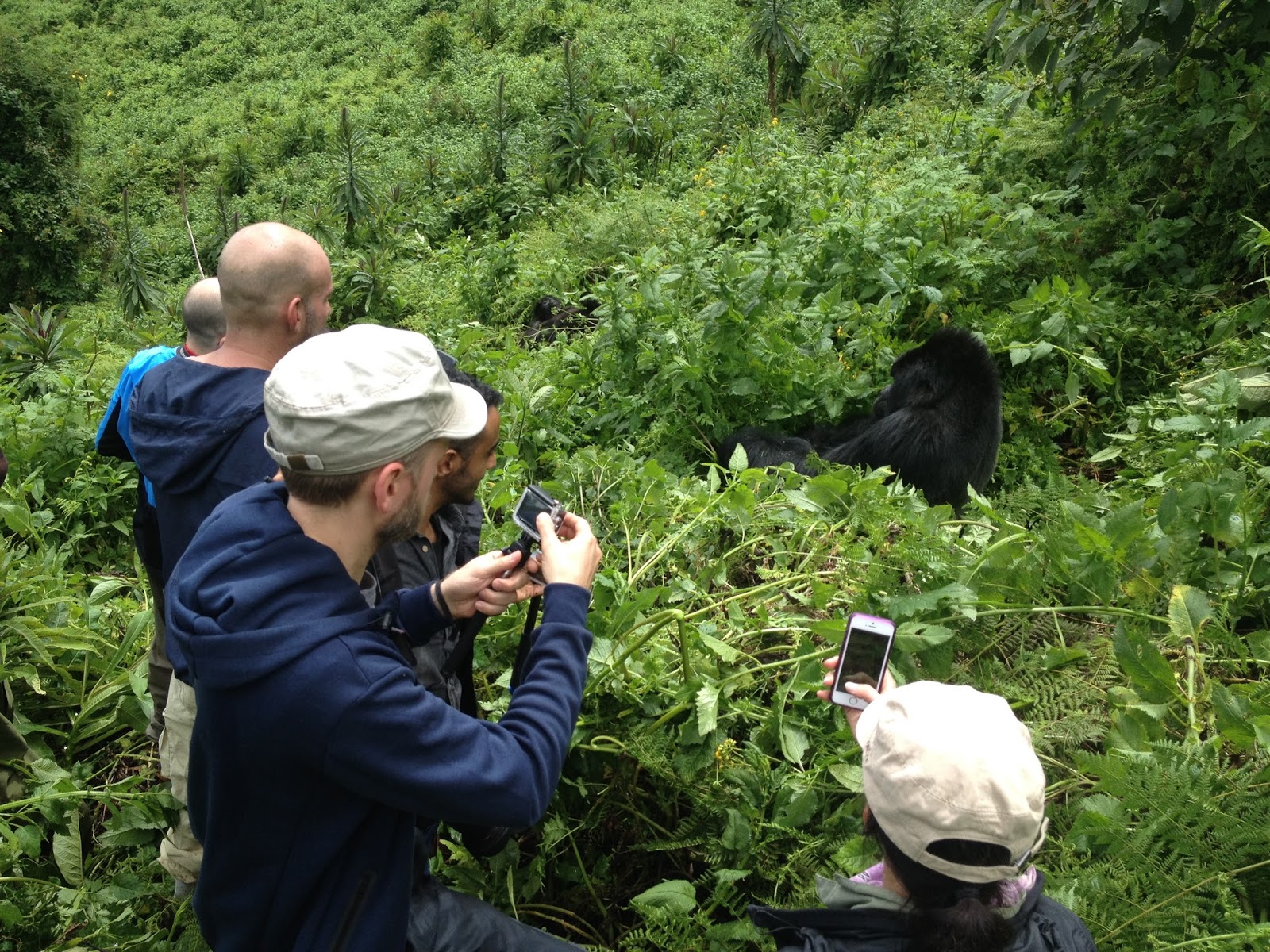
They are going to continue with their normal feeding and interactions, not caring about the visitors, although they watch with some keen interest. Sometimes one, often a playful youngster, is going to approach you with curiosity, often coming so close that you are going to be forced to move away.
When you are with your group, you should try not to make sudden movements, and keep your voice low.


Photography on a Rwanda gorilla trekking safari

When you are a keen photographer, taking your own images of mountain gorillas is among the most magical photo sessions you are going to ever experience. Remember that the light may be poor in the rainforest and that using flash is not permitted.

www.virungaprograms.com

Wednesday, 9 May 2018

CONSERVATION EFFORT AROUND VIRUNGA MASSIF BEARING FRUITS


The Virunga massif, straddling Rwanda, Uganda and Democratic Republic of Congo (DRC) is the home to the fabled but endangered Mountain gorillas. It’s also a sanctuary for various species of wildlife and plants.


 That is why the governments of the three countries have made concerted efforts towards conservation here, since Virunga is the Holy Grail of tourism industry in this region.


In Rwanda, a special ceremony is always preserved in September for the gorilla families. This is the renowned Kwita Izina ceremony, where baby gorillas are “baptized” with new names, borrowing from Rwanda tradition of naming new arrivals of babies.


The Kwita Izina ceremony is attended by the top echelons of Rwanda government, and private sector players and always conspicuously present is Rwanda leader President Paul Kagame. The presence of the president is always a clear vindication of Rwanda’s concerted efforts to ensure that these endangered primates are protected. 

The Kwita Izina ceremony is carried out with conservation in mind. Names that are attributed to the baby gorillas play a critical role in the current programmes of monitoring every individual gorilla in not only their family but also their habitat in general. The event is a uniquely Rwanda event that was introduced in the year 2005 with the aim to create awareness on conservation efforts of these endangered primates.


The Rwanda government also initiated tourism revenue sharing where some percentage of the tourism dollar goes back to the local community to uplift local living standards.
Conservation efforts around the Virunga are not only the three governments’ responsibility. There are several Non-Governmental Organisations and private sector players that have pitched tent around the Virunga chains to ensure that the communities also actively take part in conservation.


 Such organizations include Virunga Community Programs.
Working closely with the governments and the locals, these organizations have initiated different programs to make sure that human-animal conflict and poaching around the protected areas are limited. The programs include involving the community in education about conservation, facilitating income generating programs to uplift the livelihoods of the locals to convince them away from poaching, and developing local talents in various fields so that the youth exploit their natural talents and do not engage in illegal activities.
The locals are helped to sell their products to visiting tourists as souvenirs while the some of the tourists also have actively participated in community and social development in areas like health and education through payment of school fees for children coming from vulnerable families.


The Virunga Community Program has developed different programs to ensure conservation efforts around the virunga massif are realized. These include involving the local community in tree planting around the Volcanoes National Parks, facilitating development of talents in art and sports and helping the vulnerable women gain from tourism through selling traditional products like handicrafts.
Encroachment on gorilla habitat range and ecosystems primarily by humans in search of land for agriculture, the Virunga regions is surrounded by heavy population densities thus many people depend on natural resources such as water, forests and plant species. Most of these resources are found in the park thus Virunga Community Programs say it’s relevant to enfranchise communities neighboring the gorilla habitats in form of equal economic opportunities so as to reduce the strain put on gorilla habitats.
In Uganda, the ongoing census being carried out in the Bwindi Impenetrable Forest is also seen as significant effort towards conservation of the mountain gorillas. The park in Uganda is habitat to about half of the world’s remaining Mountain Gorillas. However, habitat loss, poaching, disease and civil unrest all remain major threats to gorilla populations. Consequently, accurate population numbers are crucial to protect these endangered species.
The population trend of these primates in the park show interesting figures. For instance between 1959 and 1960, there was a gorilla population of between 400 and 500. But this number reduced drastically to between 260 and 290 gorillas between 1971 and 1973. The number dwindled further to between 252 and 285 gorillas between 1976 and 1978.
A census carried out in 1981 showed there were between 242 and 266 gorillas. This is a period when Uganda was steeped in political chaos. But the 1986 census shows that the population gradually started increasing, with the number of between 252 and 285 recorded.  1989 census recorded 324 gorillas while 2003 census also saw the number increase to 380 gorillas, presenting a 17% increase since 1989.
The last count that was carried out back in the year 2010 showed there were about 480 mountain gorillas that were living in the park, showing a 26.3% increase in total population since 2003, which presented  a 3.7% annual growth rate.


In the DRC, the killing of six rangers some two months ago sent shockwaves as far as conservation is concerned. The killing of wildlife protectors is not unprecedented. In December last year, poachers killed one lowland gorilla and five chimpanzees.

Even though the governments are making efforts to make sure rangers are protected, still they daily risk their lives to protect wildlife. Protecting the animals against poachers’ onslaught-where poachers are backed by organized crime syndicate needs highly trained and dedicated group of rangers. The rangers work in tough and dangerous conditions. 

To be effective in their duties, they require top-quality modern equipment, resources and training. These are critical not only to their own safety but also to their ability to effectively offer protection to animals.

All in all, conservation initiatives by the governments, NGOs and private sector players are crucial in conservation around the Virunga. These efforts have made the numbers of the mountain gorillas and other species of wildlife to exponentially rise, while poaching has been drastically reduced. It’s hoped that with conservation efforts, there’s still a lot of heritage to look forward to in the future.

Wednesday, 2 May 2018

Booking Gorilla Permit Discount in Rwanda and DRC


Booking Gorilla Permit Discount in Rwanda and DRC 

In May 2017, the Rwanda Development Board (RDB) announced the increment of gorilla trekking fee from USD 750 to USD 1500 per person. The move, RDB, announced, was in line with its efforts to strengthen conservation efforts and contribute more to local communities living around the Volcanoes National Parks.
However, Rwanda also offers a 30% discounted price for tourists who visit the country to trek the gorillas during the low season. The low season in Rwanda is between the months of May and November. This means the tourists spend USD 1050 per person for each gorilla trek.


However, the discounted price comes with a caveat. For one to qualify for it, he or she should book for extra days or nights in other national parks of either Nyungwe Forest or the Akagera National Park.
  Nyungwe is among Africa’s oldest parks while Akagera National Park is tropical rainforest and now hosts the so called Big Five animals among many animal, plant and bird species.
Tourists also who stay pre or post-conference dates are also eligible for a discounted price of 15%.
In Uganda, the cost of gorilla trekking remains at USD 600. The gorilla trekking is a popular tourist attraction in Uganda, carried out in Bwindi Impenetrable Forest.
In Congo, tourists who want to gorilla trek pay USD 400 while during the low season they pay a discounted fee of USD 200.


Tourists can trek the gorillas in DRC in Virunga National Park and Kahuzi Biega. All these fees are only for the permit. It’s better to book in advance for the gorilla permit, transport and accommodation through Virunga Community Programs.  The money is ploughed back to promote our conservation and community development programs around the Virunga massif. In addition safari sold, we send a child to school at Kisoro International Peoples College.

www.virungaprograms.com

Sunday, 29 April 2018

GOLDEN MONKEY EXPEDITION


When God created the earth, He saw it was good. But it must have taken God a special moment to create the Golden Monkey. These beautiful creatures habitat is the Virunga National Park, Kahuzi-Biega (DRC), Volcanoes National Park and Mgahinga National Park (Uganda).


 When God created the earth, He saw it was good. But it must have taken God a special moment to create the Golden Monkey. These beautiful creatures habitat is the Virunga National Park, Kahuzi-Biega (DRC), Volcanoes National Park and Mgahinga National Park (Uganda).

 Though little known compared to their cousins, the mountain gorillas, seeing the central Africa golden monkey also is going to live you with unforgettable experience of exploring nature. Virunga Community Programs will take you right into their habitat for a day with nature’s beauty.

KNOW MOUNTAIN GORILLAS


The mountain gorillas have a very funny eating habit. They consume over 200 species of plants, and a gorilla eats 15% of its weight. A big silverback, weighing over 200 kilos, will eat 30 kilos of plant where 17 liters of water remains in its body


 They rarely drink water because of this phenomenon. The critically endangered herbivores lead peaceful social life in their habitat, and rarely attack humans. You can make a visit to these amazing creatures via Virunga Community Programs and see nature developing at its best.

www.virungaprograms.com 

GO GREEN WITH VIRUNGA PROGRAMS CONSERVATION IS THE KEY


Rwanda, the Land of a Thousand Hills tucked in the heart of Africa has an amazing and breathtaking landscape.  Its idyllic scenery has for many years wowed visitors. A Rwanda proverb that God travels everywhere but lives in Rwanda aptly describes this paradise on earth. Through Virunga Community Programs, you have the chance to see nature at its pristine.

Saturday, 21 April 2018

DISTRIBUTION OF BOOKS


Virunga Community Programs, through Virunga Charity Village is deeply involved in education of children in Goma and Bukavu. Children are our future and their education guarantees that they have a great life in future. Our education programs seek to help vulnerable children, some of who spend their lives in the streets without families. You can be part of this noble initiative by donating to the upkeep of these children and ensuring their future through education.
Fore more info 
visit  us on : www.virungaprograms.com


Saturday, 14 April 2018

LET US SAVE RANGERS

                         Published By VCP
On Monday 9 April 2018, the Democratic of Congo (DRC) was shocked when a group of five rangers together with their driver were killed in an ambush in the Virunga National Park, the famed haven for the gorillas and other endangered species.According to Joel Malembe, the park’s spokesman when talking to AFP, he said they sadly lost six rangers, adding the team was ambushed while driving between the sectors of Lulimba and Ishasha, near the border with Uganda. A seventh ranger, the team’s leader, was wounded during the attack.
On April 2, a park ranger died in an attack by armed men. He was guarding the site of a hydroelectric plant that is under construction.
The park's director, Emmanuel de Merode, a Belgian national, was himself wounded in a road ambush between the park and Goma, the capital of North Kivu, in May 2014.
All these tragic incidents should raise our own consciousness about the value of human life, while at the same time those of the animals. The rangers ironically died in the line of duty trying to protect wildlife.
These rangers have left their families behind, meeting tragic death at the hands of fellow human beings. Even though not unprecedented, it’s the magnitude of the killing at this age, when everybody should know the value of the wildlife and conservation that rankles. 
Every life is sacrosanct. That the six rangers had to lose their lives when going about their normal duty is unfathomable. And since this is not the first time such heinous crime is happening is inexcusable. We should go into deep introspection as human beings and ask ourselves some intelligent questions: what are we doing as individuals to make sure that such kind of bloodbath is consigned to the annals of history? At this age, how do we still let poachers to roam our valued forests and indiscriminately kill man and wildlife? What can be done to prevent such kind of future occurrences?
Virunga is home to about a quarter of the world's population of critically-endangered mountain gorillas, as well as to eastern lowland gorillas, chimpanzees, okapis, lions, and elephants among others.
One of the most important conservation sites in the world, it covers 7,800 square kilometers (3,011 miles), or three times the size of Luxembourg, along a swathe of eastern DR Congo abutting the border with Uganda and Rwanda.
For many years, the park has been hostage to marauding poachers that has brought a lot of suffering to the same people who have put their lives on the line to protect the wildlife. Virunga Community Programs believe that no life should be lost.
We train rangers and guides that protect our environment, and make sure conservation efforts around the Virunga is realized. Furthermore, knowing that the poachers also need sustainable source of income, we make sure we integrate them in income generating programs so that we have a win-win situation for both human and wildlife.
You too can be part of the solution. Just click our website www.virungaprograms.com and you can know the level of support we do so that you also can help us to completely wipe out this menace that is affecting both human and wildlife.

Monday, 9 April 2018

GORILLA ADVENTURE

Happiness resides in the heart of people. When expressed out it has a cathartic effect.


Trekking the famous Rwanda mountain gorillas has for many years provided visitors this sort happiness. As only people who have done it can attest. They are rare, they are funny and yet when you see them, part of your life’s adventure is achieved in a most profound way. Link with Virunga Community Programs for an adventure of a lifetime trekking these amazing primates.

www.virungaprograms.com


KISIMBA-IKOBO: NEGLECTED NATURE PARADISE


Published By www.virungaprograms.com

Kisimba-Ikobo Nature Reserve is 150 Kilometers from Goma Town, Eastern part of Democratic Republic of Congo (DRC). However, despite community wars happening there in this part of the world, it has continued to maintain relative peace, hosting nature at its pristine. It hosts lowland gorillas, chimpanzees, antelopes, okapis, elephants, buffaloes, and many species of monkeys, including the colobus monkey among others.

This is a nature paradise of earth worth visiting. According to Francis Ndagi, coordinator of Virunga Community Programs of Virunga massif, Kisimba-Ikobo hosts nature. “You are going to meet all these animals, happy in their natural habitat. This is where man falls in love with nature,” says Ndagi.
The surface is 1,298,488 square kilometers. It was legally recognized in 2002 by customary chiefs and local leaders as a national reserve, and officially recognized. In August 2008, it was recognized by the government DRC as a natural reserve.
When visitors come to any place, they want to see wild animals and plants in their natural habitats. Naturally, Kisimba-Ikobo Nature Reserve has all it offers to sustain different plant and animal species.
The nature reserve is located in the world’s most tropical forests, in an area rich in biodiversity that supports several endangered species including the gorillas.
In 2009, according to https://gorillafund.org/community-reserves-receive-grant/, the Walt Disney Company, in conjunction with Conservation International, granted $4 million to protect the Tayna Nature Reserve and the Kisimba-Ikobo Reserve in eastern DRC, which are home to endangered Grauer’s gorillas as well as many other important and unique species.
The publication reports that (the) have been granted legal status by the Congolese government equal to its national parks, with management carried out by local communities. They belong to a network of ten such reserves (in a consortium called UGADEC) created from lands donated by traditional leaders who have managed them for generations. The Fossey Fund is the primary partner with these communities, helping them to protect wildlife, support health, education and economic development, and carry out scientific research to direct their conservation efforts, with support from USAID.
According Ndagi, Tourism activities is quite low in the region because poaching is rampant, illegal mineral mining, deforestation; rangers are not being paid (in time) while the forest is so big to support local rangers efforts.
“They don’t have (enough) equipment to monitor the animals and capacity building there is almost zero. Even though it’s showing its face in the world, even simple things like infrastructure is a problem. However, what I have seen (from my foray there) there is women are actively involved in conservation, more than the men,” says Ndagi.
Last year between December 22 and 25 December 2017 poachers killed one lowland and five chimpanzees at station Kishonja in the national reserve.
Ndagi says private sectors like Virunga Community Programs are established to save Kisimba-Ikobo Nature Reserve. “When time comes, we are going to finance community development, community conservation, education, capacity building, management of forests and provide support and advocacy.”.
Kisimba-Ikobo Natural Reserve is a background reserve in DRC that is rich in nature. You can visit this paradise on earth day.


www.virungaprograms.com
Shared publicly